Planetary challenges – opening the conversation
Background
Over the past couple of years I’ve worked with many teams to help integrate climate awareness (and action!) into their daily work.
Leading many of these sessions I learned how important it is to address the strong feelings people have about our planetary challenges, before diving into any of the work.
Climate change, biodiversity loss, pollution…. Themes that can make your heart sink. Or themes that you don’t want to face because of the magnitude of it all. Themes that can easily make you feel powerless.
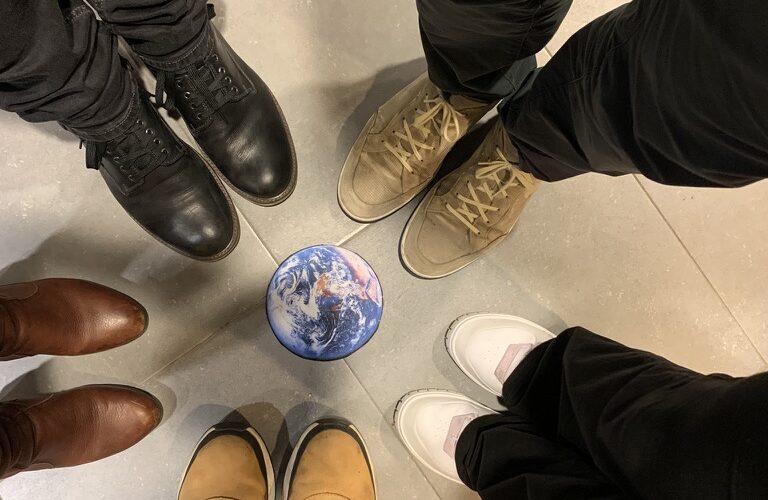
So I always open the conversation with an exercise that encourages participants to express how they feel about the state of our planet: by putting a picture of the Earth on the ground and asking everyone:
- Where do you stand in relation to our planet and its challenges? Find a place in the room that represents where you emotionally stand.
- Do you face our planetary challenges directly, or do you find yourself looking sideways, maybe turning your back?

Then I invite them to turn inward for a moment, to notice what that position feels like for them. Standing close, standing further away, facing the Earth or turning away from it.
What comes up
Every time I run this, many different kinds of responses come up. Some people stand right on the Earth, speaking about their love for it and how they try to reduce their own footprint in daily life. Others express their anxiety, fear of loss, etc. And there will always be one or more participants standing in the furthest corner of the room, admitting they’d rather not engage with the topic at all, because they don’t know what they could possibly do about it. Or they admit that they are just not interested. Others turn their backs, or face the Earth hesitantly, describing the tension between wanting to do good and at the same time choosing convenience: commuting by car, flying, eating meat.
Across every session I’ve run, a few themes come back over and over again:
- Guilt: the pull between what one could do and what one is willing to give up, and the friction of not sacrificing everything.
- Frustration: with governments, companies, regulation; the sense that not enough is being done about climate change, pollution, biodiversity loss.
- Powerlessness: the feeling that individual impact is too small to matter.
I ask each person to share their feelings and views in a sentence or two. It sets the stage immediately and helps create understanding of where everyone else stands, before a single idea has been discussed.
Why this matters
The point of this exercise is not so much to resolve any of these feelings, but to simply let everyone express their feelings, and be heard without judgment. To acknowledge feelings of guilt, grief, anxiety, so people can lean in instead of shutting down.
In my experience, the quality of the following conversation is positively impacted when people have shared their feelings and found common ground in learning that other people struggle with these topics too.
If you want to facilitate this conversation but your team is online, use this Mural board instead!