Workshop ‘Planet Earth as Our Stakeholder’ (updated version)
How it started
A few years ago, while searching for a meaningful way to act on climate change, I started to wonder: what if I brought a sustainability perspective into my own Agile teams?
I delved into the topic of sustainable IT and started with a Planet Retrospective for my Scrum team, working through the Principles of Green Software Engineering. We talked about what steps our team could take to reduce the carbon footprint of our services.
Looking at our work through a sustainability lens was new for the team, but everyone immediately agreed on its importance. By the end of that first session, we estimated that optimizing our landscape and decommissioning legacy components could meaningfully reduce our footprint.
That made me wonder:
What if every Agile team had this conversation?
So I built a workshop to help teams look at their work through a sustainability lens, and to help them define their own first steps forward. What started as a single session with my own team grew, and over the past few years I’ve run the workshop with many teams.
I originally built it for IT teams, but the exercises work just as well for any team looking at its own impact. It raises climate awareness and ends with each participant defining actionable steps for reducing their (IT) carbon footprint. Steps they can actually start on right away!
Download the materials for an in-person workshop, or use the Mural link if you want to facilitate this session online: Open the Planet as a Stakeholder Mural template.
Here’s the basic set-up.

Planet Check-in
Before we dive into the work, we always start with a Planet Check In. I put a picture of the Earth on the floor and ask people where they stand in relation to it: close by, far away, facing it, or turned away.
Climate change is a topic people feel strongly about, and giving that feeling room before the workshop starts changes everything about what follows. It’s worth doing properly. I’ve written more about why, and how, in a separate post on the Planet Check In.
Round 1: Brainstorm
What is needed to halve our IT carbon footprint by 2030?
- Write your ideas on post-its — one idea per post-it.
- Discuss your ideas in pairs. Write down any new ideas that come up.
- Form groups of four and brainstorm further.
- Bring it back to the full group for a plenary discussion.
Round 2: Impact & Influence
Round 2a: The Impact Quadrant
Which ideas from the brainstorm matter most?
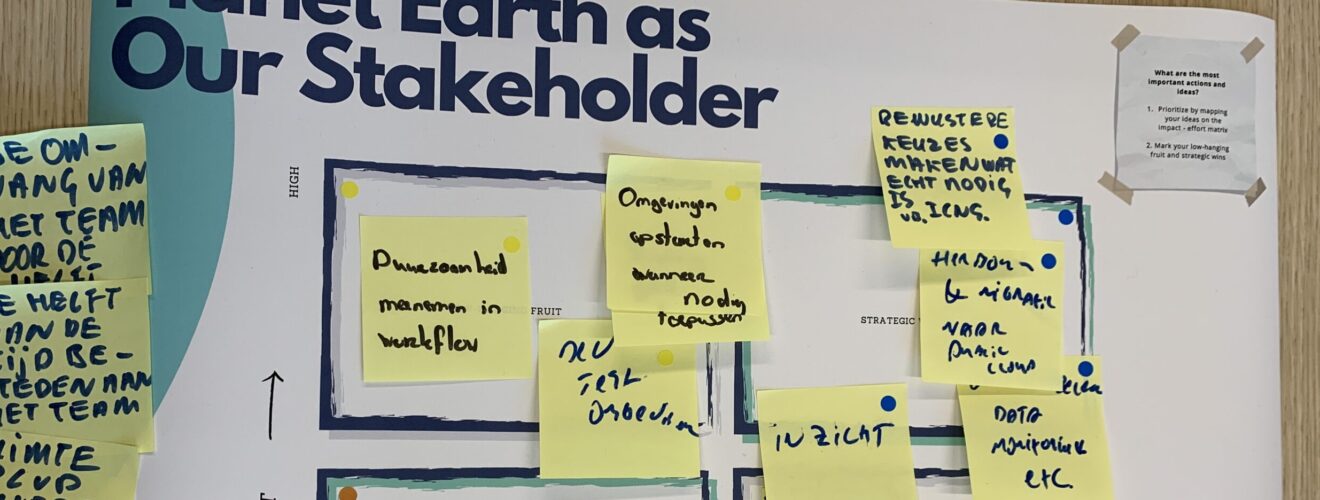
Before plotting anything on the circle of influence, prioritize. Take the ideas from Round 1 and map them on an impact–effort matrix: how much difference would this make, against how much effort would it take?
- Plot your ideas on the impact–effort matrix.
- Mark your low-hanging fruit (high impact, low effort), and your strategic wins (high impact, high effort) worth planning for.
- Carry your highest-value ideas forward into Round 2b.
Round 2b: Circle of Influence
How can you contribute from your own role?
I use three circles for this exercise: Control at the center, Influence around it, and Concern as the outer ring. Most ideas land in Concern at first: things you care about but have no direct hand in. The work of this round is to pull those ideas inward, one size smaller at a time.
- Plot your prioritized ideas from Round 2a onto the circle of influence.
- In the same groups of four, try to expand your circle of influence: take the ideas sitting in the outer rings and rephrase them smaller, until they become something you could actually act on.
- Discuss your findings with the full group.
Here’s how that shift usually works in practice. Say your idea is “I want green criteria to weigh into tender management”, but tender management isn’t something you have anything to do with. That idea sits firmly in your circle of Concern.

Instead of leaving it there, ask: what’s a smaller version of this I could do something about? Maybe you realize you know someone in tender management. That pulls the idea into your circle of Influence. Shrink it further and it becomes an action you can take right now, in your circle of Control: send that person a message.
This is how the two rounds come together: some of your low-hanging fruit from Round 2a turns out to already sit in your circle of Control.

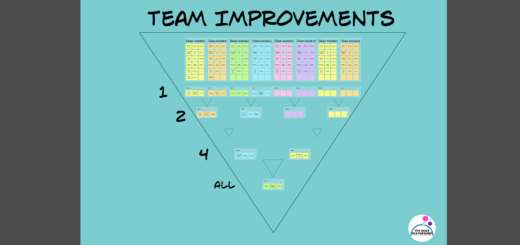
Round 3: 15% Solutions
What’s the first step you can take without needing approval or resources from anyone else?
- Write down actions you could start on right away.
- Refine these in your breakout group. Help each other define actions that are both impactful and achievable within the coming sprint.
The cool thing? People leave the session with a concrete backlog: things they can pick up in the coming sprint.
What I notice again and again is that by the end of the workshop people feel really motivated. Despite the magnitude of climate change, they discover they can still do something tangible. Something within their own circle of influence.
The feedback I get after a workshop, is that people often feel inspired, motivated, happy! And ready to take action. As one participant put it:
“I never realized I could actually do something against carbon emissions in my own work, but it turns out I can!”
Need a Facilitator?
Don’t hesitate to contact me.
For more inspiration
Here are some sources for more inspiration on Sustainable Agility and IT:
Sustainability Incubator Program